Self-guided walk · CBD & river reach
The City Essentials Heritage Walk
The sandstone, the convict brick and the river-city story, told building by building across the CBD.
Before it was a subtropical capital of glass towers, Brisbane was a penal settlement — one of the harshest in the colony — built by convict labour on a bend in the river the Turrbal people call Meanjin. Remarkably, some of that first city still stands, hemmed in by the modern one.
This is the orientation walk: the single loop that makes sense of the whole CBD. It runs from the oldest building in Queensland down to the river, taking in the grandest sandstone the colony could afford, and it's the one to do first if you only do one.
“Brisbane wears its history lightly — a convict windmill on a hill, a French-Renaissance treasury turned casino, a city hall that was once the most expensive building in the country. You just have to know to look up.”
The Route
Walk it in order, or drop into any stop. Coordinates are included for every point so you can open each one straight in your maps app.
The Old Windmill
Wickham Terrace, Spring Hill-27.4652, 153.0224
Begin on the hill. The Old Windmill, built by convict labour in 1828, is the oldest surviving building in Queensland and one of the two oldest in the state. Its sails never worked reliably, so the colony forced convicts to power a treadmill inside it instead — a punishment so notorious it shadowed the whole settlement.
It later served as a signal station and, in 1934, as the site of some of the first experimental television broadcasts in Australia. Stand here first: you are at the literal high point of the convict town, looking down over everything the walk is about to descend through.
Insider Tip
You can't go inside, but circle to the uphill side for the plaque most people miss — and the best framed view back down over the CBD toward the river.
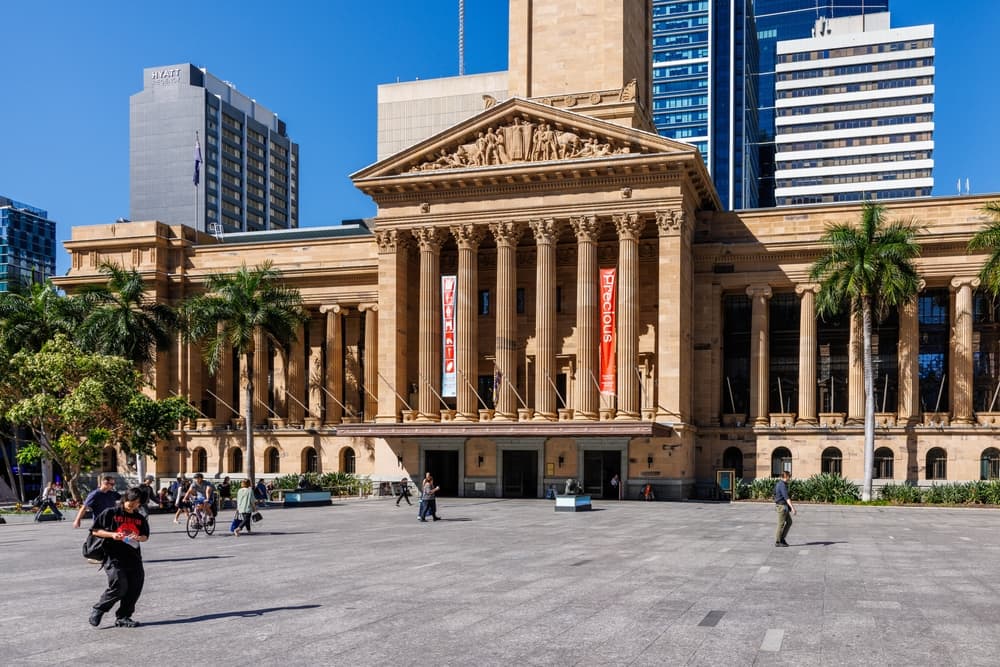
Brisbane City Hall & King George Square
King George Square-27.4689, 153.0231
Down the hill, Brisbane City Hall opened in 1930 after nearly a decade of construction and was, at the time, the most expensive building in Australia. Its clock tower — once the tallest structure in the city — still runs a caged, original-cage lift to a viewing platform below the bells.
The great circular auditorium inside seats two and a half thousand under a domed ceiling. Cross King George Square to take in the full sandstone-and-portico façade; this was Brisbane declaring, in stone, that it had stopped being a colonial outpost and started being a capital.
Insider Tip
The heritage clock-tower lift ride to the observation platform is free, but numbers are capped each departure — collect a ticket from the Museum of Brisbane desk on level 3 as soon as you arrive.
The Treasury Building
Queen Street / William Street-27.4707, 153.0223
Toward the river stands the Treasury Building, an Italian-Renaissance palazzo in Helidon sandstone built in stages between 1883 and 1928 to house the colony's finances. It fills an entire city block, its arcaded façades wrapping three streets in a display of civic confidence.
In one of the city's great ironies, the building that once guarded Queensland's treasury is now a casino — open around the clock beneath the same 19th-century ceilings. Walk the William Street colonnade for the full effect of the stonework the colony's gold and wool paid for.
Insider Tip
Walk the full William Street colonnade rather than cutting across Queen Street Mall — it's the only angle where you can read the building's original three-storey symmetry without a crowd in the frame.
The Commissariat Store
William Street, riverside-27.4726, 153.0209
End at the river, at the Commissariat Store — built by convicts in 1829 on the bank of the Brisbane River to hold the settlement's rations and supplies. Along with the windmill where you began, it is one of only two convict-era buildings still standing in the city, and it sits on its original stone river wall.
Today it houses the Royal Historical Society of Queensland and a small museum. Finishing here closes the loop that opened on the hill: from the windmill that punished the convict town to the store that fed it, with two centuries of sandstone ambition in between.
Insider Tip
The small museum upstairs is easy to miss and rarely busy — the third floor still shows the original convict-hewn timber beams, and entry is a few dollars that go to the historical society.
Good to know
How long is the walk and how far?
About two hours over 2.4 kilometres, rated a gentle walk. It runs four landmarks from Spring Hill down to the river — a little longer than the laneway walks, but still an easy morning or afternoon.
Where does it start and finish?
It begins uphill at the Old Windmill on Wickham Terrace in Spring Hill — the oldest building in Queensland — and descends through the CBD to finish at the Commissariat Store, on the river at William Street.
When's the best time to walk it?
Morning or late afternoon is best, when the sandstone catches the light and the CBD is quieter. It's a daytime heritage walk rather than an after-dark one.
Is it free?
Yes — the walk is free and self-guided. A couple of sites charge a small entry (the Commissariat Store museum is a few dollars); the private guided tour we link is a separate, paid booking.
Which buildings can I go inside?
Three of the four. You can't enter the Old Windmill, but City Hall — including its free clock-tower lift — the Treasury, now a 24-hour casino, and the Commissariat Store, home to a small museum, all welcome visitors.
Staying nearby? Where to stay in the laneway district